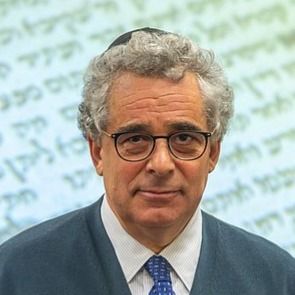
ICCJ Awards 2026 Seelisberg Prize to Rabbi Dr.David Meyer
July 12, 2026
HANOVER, Germany — July 12, 2026 — Rabbi Dr. David Meyer, a scholar of rabbinic literature and longtime professor at the Cardinal Bea Centre for Judaic Studies of the Pontifical Gregorian University in Rome, has been awarded the 2026 Seelisberg Prize. The prize was presented this evening at the opening event of the International Council of Christians and Jews' (ICCJ) 2026 conference, held in Hanover under the theme “Repentance, Repair, and Reconciliation: Religious Resources for Tumultuous Times.”
Established in 2022, the Seelisberg Prize is awarded annually by the ICCJ and the Paris Lodron University of Salzburg. The prize commemorates the groundbreaking conference held in Seelisberg, Switzerland in 1947 that addressed centuries-old "teachings of contempt" that poisoned Jewish-Christian relations and contributed to antisemitism. The foundational conference produced "A Call to the Churches: The Ten Points of Seelisberg," challenging Christian theology by eliminating antisemitic teachings and emphasizing Christianity's Jewish roots. Meyer becomes the fifth laureate, following Amy-Jill Levine (2022); Joseph Sievers (2023); Edward Kessler (2024); and Barbara U. Meyer (2025).
“David Meyer has spent decades building genuine trust between Jews and Christians through his teaching at the Pontifical Gregorian University,” said Anette Adelmann, ICCJ General Secretary. “He is a truly deserving recipient of this year's Seelisberg Prize.”
“I have had the honor of calling David both a colleague and a friend, and I have always appreciated the way his scholarship is rigorous and generous in equal measure,” said ICCJ President Rabbi Dr. David Fox Sandmel.
In his laudatio before Meyer’s keynote address, Dr. Massimo Gargiulo, Director of the Cardinal Bea Centre for Judaic Studies at the Pontifical Gregorian University offered a beautiful summation of Meyer’s approach to teaching and presence, “Teaching is the activity that most fully engages him, the one he would never miss, the one in which his enthusiasm reaches its highest expression. The care with which he prepares his lectures, the clarity of his explanations, his ability to engage students, his constant invitation for them to become active participants, and his almost limitless generosity in supervising their theses are truly exemplary.”
Born in Paris in 1967, Meyer was ordained a rabbi at the Leo Baeck College in London in 1997 and subsequently earned a PhD in religious studies from the Katholieke Universiteit Leuven (KU Leuven) in Belgium. From 1997 to 2006 he served as a community rabbi in Brussels and Brighton before moving into academic life. Since 2010, he has taught Classical Rabbinic Literature and Contemporary Jewish Thought at the Cardinal Bea Centre for Judaic Studies, and he regularly teaches at two Catholic universities in Peru as well as in China. He is the author of numerous articles and books in French, English, and Portuguese on rabbinic and interreligious themes, including Painful Verses: Bible, Gospel and Quran between conflict and dialogue and God, Checkmate! Midrashic Hermeneutics as Theological Medium.
Accepting the award, Meyer said he did not think of himself primarily as a scholar of Jewish-Christian dialogue — he lives it, he said, rather than teaching it — but as someone working in the borderland between rabbinic studies and Christian theology, seeking to make rabbinic sources a resource for contemporary reflection in both traditions.
In his keynote address, titled “Beware of Soothing Words in Tumultuous Times: Speak to us smooth things, prophesy illusions (Is 30:10),” he reflected on friendship and trust as the guiding principles of that work, describing it as a form of “trespassing” across denominational boundaries — always respectful of the integrity of both traditions, he said, and never a hybridization of them. Turning to the conference theme of repentance, repair, and reconciliation, Meyer cautioned against what he called “soothing words”: the comforting religious and political language that can obscure rather than confront difficult realities. He drew on the prophetic warnings of Jeremiah and Isaiah against false hope, on the Book of Job's portrait of a God whose presence is difficult to discern amid suffering, and on Gershom Scholem's warnings about the dangers latent in secularized biblical concepts such as election, land, and promise. Drawing further on a Talmudic image contrasting the plastering-over of rough writing with the rougher text beneath it, he distinguished between words made merely smooth and pleasant and the harder, “peeled” reality underneath, illustrating the distinction with readings on the cancellation of debts in Deuteronomy and on the reconciliation of Joseph and his brothers in Genesis. Nice-sounding concepts in tumultuous times, he concluded, do not guarantee success and can even be deceptive — but recognizing that danger opens the way to a more honest possibility, including the ICCJ's own trilateral dialogue with Muslims, which he described as valuable precisely because it introduces the dynamic of a “third,” though, he added, that too is not guaranteed to succeed.
The ICCJ conference in Hanover continues through July 15 and brings together scholars, clergy, and lay leaders from ICCJ's member organizations around the world to address the conference theme.